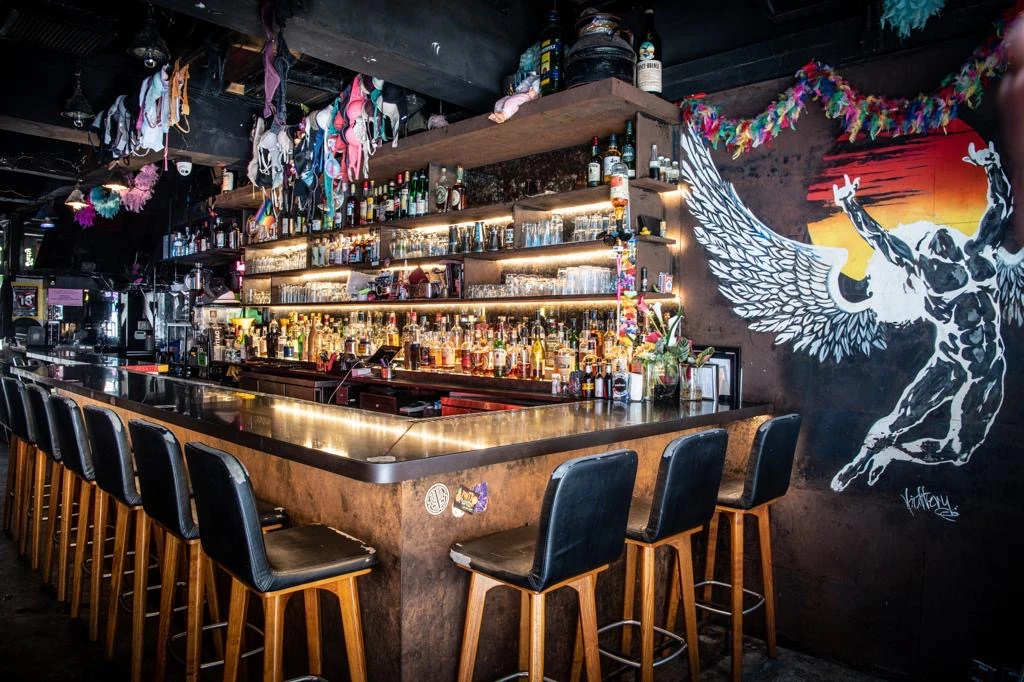
A cocktail bar
The Pontiac
Not gay-only, but a longstanding LGBTQ+ favorite in Central: an inclusive dive cocktail bar with a high-energy, come-as-you-are atmosphere.
52 spots
Hong Kong
From bars in Central and Sheung Wan to Jordan and men’s venues in Kowloon. Discover queer life across distinct neighbourhoods on Hong Kong Island and Kowloon.
The published LGBTQ+ bars are spread across Central, Sheung Wan, Causeway Bay and Jordan. Men’s saunas and wellness venues also appear in Wan Chai, Mong Kok and Tsim Sha Tsui, while community and cultural spaces offer daytime options. These are separate places across Hong Kong Island and Kowloon, not one nightlife district. Check the chosen venue’s address and current access before going.
Choose a space, then check its address and official notice for your date. The complete place list remains available.
A cocktail bar
Not gay-only, but a longstanding LGBTQ+ favorite in Central: an inclusive dive cocktail bar with a high-energy, come-as-you-are atmosphere.
A bar on Wyndham Street
New-generation queer bar and event venue in Central with drag nights, DJs, comedy and themed parties.
Sauna visiting conditions
Well-known Central gay sauna operating since 1991, with steam and dry sauna, jacuzzi, private cabins and complimentary snacks.
Confirm opening hours, admission, fees and minimum orders for your date on official channels.
Use the official channels below to confirm schedules, reservations and conditions.
Check the official menu and happy-hour terms before ordering.
Official informationSources checked: 2026-10-02Confirm your date’s menu, minimum orders, events and opening hours with the venue.
Official informationSources checked: 2026-10-02Official site: daily 13:00–23:00. Confirm current admission price, discounts and entry conditions directly.
Official informationSources checked: 2026-10-02Near Me discovers surrounding places. Use maps and transport information for routes and your journey home.
Bar · Sheung Wan / Jervois Street
Bar · Central / Wyndham Street
Bar · Causeway Bay / Sharp Street East
Bar · Causeway Bay / Sharp Street East
Bar · Sheung Wan / Bonham Strand
Bar · Central / Pottinger Street
Bar · Central / Pak Tsz Lane
Bar · Jordan / Nathan Road
 Photos provided by the venue · 3
Gay-popular / mixed · Central / Old Bailey Street
Gay club · Sheung Wan / Mihn Club
Gay sauna · Causeway Bay / Hennessy Road
Gay sauna · Wan Chai / Thomson Road
Gay bar
City at a glance
Place guideHong Kong currently has 52 listed places: 23 daytime and 29 nightlife choices. Near Me shows only 51 places with supported location evidence.
Affiliate link · AFTERORA may receive a commission at no extra cost to you; proceeds help cover site operating costs.
A dense international city shaped by Cantonese culture, maritime trade and a long period of British administration.
Archaeological evidence shows human settlement in Hong Kong for roughly 6,000 years, with Neolithic coastal communities documented by the Antiquities and Monuments Office.
After the First Opium War, the Treaty of Nanking ceded Hong Kong Island to Britain. This began more than a century of British colonial administration.
Kowloon south of Boundary Street was ceded in 1860, while the New Territories were leased to Britain for 99 years in 1898. These arrangements shaped the modern territorial outline of Hong Kong.
Japan attacked Hong Kong on 8 December 1941 and British forces surrendered on 25 December. The occupation lasted three years and eight months until Japan's surrender in 1945.
Hong Kong's population rose rapidly after the war, from about 600,000 in August 1945 to around 1.8 million by the end of 1947 and about 2.2 million by 1950. Migration and rebuilding reshaped the city.
Manufacturing expanded quickly in the post-war decades, turning Hong Kong from a trading entrepôt into a major export-production centre. Textiles, garments, plastics and electronics were important parts of that transition.
Labour disputes escalated into months of violent disturbances, bombings and confrontation in 1967. The crisis was followed by policing changes and broader efforts to address governance and social conditions.
As production costs rose and regional manufacturing networks expanded, Hong Kong's economy shifted increasingly toward trade, logistics, finance and other services. Its role as an international business hub deepened before 1997.
China and the United Kingdom signed the Joint Declaration on 19 December 1984, setting out the arrangements for the transfer of sovereignty in 1997. It also framed the future Special Administrative Region.
The Basic Law was adopted on 4 April 1990 and took effect on 1 July 1997, when China resumed sovereignty and the Hong Kong Special Administrative Region was established. The constitutional framework is based on 'one country, two systems'.
Hong Kong experienced months of mass protests and unrest in 2019 amid a major political crisis. The Hong Kong National Security Law took effect on 30 June 2020 and materially changed the legal environment for national-security offences and public political activity.
The Safeguarding National Security Ordinance took effect on 23 March 2024, completing local legislation under Article 23 of the Basic Law. It added and updated national-security offences and related enforcement powers.
AIDS Concern was founded in 1990 and became Hong Kong's first NGO dedicated to HIV/AIDS, including an early AIDS hotline. It later built targeted outreach with gay men and other communities.
Hong Kong decriminalised private consensual sexual activity between men in 1991, initially with an unequal age threshold of 21. Later litigation and legislation removed that age disparity.
AIDS Concern records gay-community HIV prevention outreach from 1995 and outreach testing in gay saunas from 2001. These programs became an important part of community health infrastructure.
A community coalition formed in 1999 after Hong Kong's first LGBT+ festival and was restructured and renamed Pink Alliance in 2011. It later became a registered charity and remains publicly active.
The organizer's history identifies 15 October 2004 as Hong Kong's first Pride Parade, with about 100 participants. The 2008 parade belongs to a later organizing lineage and should not be described as the first ever.
From 2005 to 2008, local groups organized IDAHO-related public actions. In 2008 a dedicated organizing committee launched 'Celebrate Love', drawing more than 1,000 people and establishing the modern annual Pride lineage.
The 2005 Leung TC William Roy litigation found key unequal male same-sex age-of-consent provisions unconstitutional. Subsequent legal changes culminated in an equal age threshold of 16; the court case itself should not be presented as having rewritten every provision instantly.
The 2007 Yau Yuk Lung judgment struck down discriminatory treatment in the criminal law and strengthened constitutional equality protections. Hong Kong still has no single comprehensive anti-discrimination ordinance covering sexual orientation, gender identity and intersex status across all sectors.
Queer Straight Alliance was formally registered in 2008 as a student-led network linking LGBTQ+ and allied students across Hong Kong universities. It remains publicly active in 2026.
Pink Dot Hong Kong held its first event in 2014 as a public show of support for sexual and gender diversity. The project continues with public programming, including 2026 online and discussion formats.
In QT v Director of Immigration, the Court of Final Appeal rejected differential treatment of a same-sex civil partner for a dependant visa. Current immigration guidance recognizes qualifying foreign same-sex marriages, civil partnerships and civil unions for dependant applications, subject to normal requirements.
Leung Chun Kwong's Court of Final Appeal victory required equal civil-service spousal benefits and joint tax treatment for his overseas same-sex marriage. The ruling is important but did not create local marriage equality.
Hong Kong law does not automatically give both members of a same-sex couple identical parental status. Courts can make guardianship, custody or care arrangements for a non-biological parent based on the child's interests, but this is not general joint-adoption equality.
In Sham Tsz Kit, the Court of Final Appeal did not recognize a constitutional right to same-sex marriage. By majority, it held that the government had a positive obligation to provide an alternative legal framework recognizing same-sex partnerships with appropriate rights and obligations.
In Q & Tse, the Court of Final Appeal found the former requirement of full sex reassignment surgery for changing the sex entry on a Hong Kong identity card disproportionate. The judgment concerned the ID-card marker, not a general self-identification system for legal sex.
From 3 April 2024, full sex reassignment surgery is no longer mandatory for changing the sex entry on a Hong Kong identity card. Applicants must still meet specified surgical, medical/hormonal and residency conditions, so this is not unrestricted self-ID and the ID marker does not determine legal sex for every purpose.
In Ng Hon Lam, the Court of Final Appeal upheld protection against discriminatory exclusion of an overseas same-sex spouse from intestacy and related inheritance provisions. This is case-based recognition and not general local marriage equality.
The government introduced a same-sex partnership registration bill in 2025 in response to the 2023 judgment, but the Legislative Council rejected it at second reading on 10 September 2025 by 14 votes to 71, with one abstention. As of 14 September 2026, no alternative partnership registry created by that bill is in force.
Pink Alliance, Queer Straight Alliance and AIDS Concern show current public activity in 2026. Transgender Resource Center's official site says its operations are suspended from 2026 and that its email is not a counselling or support channel, so it should not be presented as a current frontline service.
Current messaging and public business-contact channel in Hong Kong. Use it as a practical discovery/contact layer, not as proof of LGBTQ+ relevance or popularity.
Current privacy-focused messaging service; public venue use must be verified first-party. Use it as a practical discovery/contact layer, not as proof of LGBTQ+ relevance or popularity.
Current messaging and public-channel service; private invitation links are excluded. Use it as a practical discovery/contact layer, not as proof of LGBTQ+ relevance or popularity.
Current messaging service available in Hong Kong; no claim of national rank. Use it as a practical discovery/contact layer, not as proof of LGBTQ+ relevance or popularity.
Current messaging service accessible in Hong Kong; never infer a venue account. Use it as a practical discovery/contact layer, not as proof of LGBTQ+ relevance or popularity.
Current direct-message and public-page contact layer. Use it as a practical discovery/contact layer, not as proof of LGBTQ+ relevance or popularity.
Current discovery and direct-message channel; only verified official accounts may be bound to a venue. Use it as a practical discovery/contact layer, not as proof of LGBTQ+ relevance or popularity.
Current Hong Kong storefront and local-use evidence; proximity, profile and media can expose identity or location. Use it as a practical discovery/contact layer, not as proof of LGBTQ+ relevance or popularity.
Current Hong Kong storefront and local-use evidence; nearby, photo and private-album features create outing exposure. Use it as a practical discovery/contact layer, not as proof of LGBTQ+ relevance or popularity.
Current Hong Kong storefront from iRainbow Hong Kong Limited; local research documents the Blued lineage, but current brand features still require privacy caution. Use it as a practical discovery/contact layer, not as proof of LGBTQ+ relevance or popularity.
Current Hong Kong storefront and local-use evidence; location and user-content features can expose identity. Use it as a practical discovery/contact layer, not as proof of LGBTQ+ relevance or popularity.
A Hong Kong storefront is current, but independent evidence of a current Hong Kong user network was not verified beyond storefront availability. Use it as a practical discovery/contact layer, not as proof of LGBTQ+ relevance or popularity.
Current POI, review and transit discovery layer. Use it as a practical discovery/contact layer, not as proof of LGBTQ+ relevance or popularity.
Hong Kong currently supports Apple Maps navigation and transit features. Use it as a practical discovery/contact layer, not as proof of LGBTQ+ relevance or popularity.
Official HKSAR map for addresses, buildings and public facilities. Use it as a practical discovery/contact layer, not as proof of LGBTQ+ relevance or popularity.
Current Hong Kong restaurant search, review, map and booking platform. Use it as a practical discovery/contact layer, not as proof of LGBTQ+ relevance or popularity.
Current Hong Kong activities, accommodation and transport booking service. Use it as a practical discovery/contact layer, not as proof of LGBTQ+ relevance or popularity.
Current Hong Kong hotel, flight and attraction booking service. Use it as a practical discovery/contact layer, not as proof of LGBTQ+ relevance or popularity.
Current Hong Kong accommodation booking and review service. Use it as a practical discovery/contact layer, not as proof of LGBTQ+ relevance or popularity.
Current Hong Kong accommodation search, booking and review service. Use it as a practical discovery/contact layer, not as proof of LGBTQ+ relevance or popularity.
Current MTR journey planning, station and transport-information app. Use it as a practical discovery/contact layer, not as proof of LGBTQ+ relevance or popularity.
Current Hong Kong public-transport journey planner with location exposure when used live. Use it as a practical discovery/contact layer, not as proof of LGBTQ+ relevance or popularity.
Current Hong Kong taxi-call app; exact service identity replaces the ambiguous generic 'HKTaxi' label. Use it as a practical discovery/contact layer, not as proof of LGBTQ+ relevance or popularity.
Current Hong Kong taxi/ride-hail option; pickup, drop-off and account data form an itinerary trail. Use it as a practical discovery/contact layer, not as proof of LGBTQ+ relevance or popularity.
Official Transport Department route, traffic and public-transport information service. Use it as a practical discovery/contact layer, not as proof of LGBTQ+ relevance or popularity.
Current public-page and event discovery surface; private groups are not stored. Use it as a practical discovery/contact layer, not as proof of LGBTQ+ relevance or popularity.
Current public social-discovery surface with account-linkage exposure. Use it as a practical discovery/contact layer, not as proof of LGBTQ+ relevance or popularity.
Current public organizer video and live-stream discovery surface. Use it as a practical discovery/contact layer, not as proof of LGBTQ+ relevance or popularity.
Current public/pseudonymous Hong Kong forum; LGBTQ+ relevance varies by thread and posts can still expose identity context. Use it as a practical discovery/contact layer, not as proof of LGBTQ+ relevance or popularity.
Current Hong Kong public group/event discovery service; membership or RSVP may reveal interests. Use it as a practical discovery/contact layer, not as proof of LGBTQ+ relevance or popularity.
Current Hong Kong public event-ticket discovery service; event participation may create account and itinerary data. Use it as a practical discovery/contact layer, not as proof of LGBTQ+ relevance or popularity.
Current public Hong Kong LGBTQ+ organization and community-information channel. Use it as a practical discovery/contact layer, not as proof of LGBTQ+ relevance or popularity.
Current public HIV/LGBTQ+ health and community-information organization. Use it as a practical discovery/contact layer, not as proof of LGBTQ+ relevance or popularity.
Dating, map and transport services can create a detailed location trail. Use the least precise permission you need, and remember that hiding a displayed distance may not remove all proximity clues.
Phone numbers, contact syncing and linked social accounts can connect a dating profile to work, family or a real-name identity. Limit cross-linking if outing is a concern.
Public posts, screenshots and leaked personal data can expose identity, address or workplace. Save URLs, screenshots and timestamps; Hong Kong's privacy regulator has a dedicated doxxing enquiry/complaint line at 3423 6666.
Treat a polished profile or verification badge as one signal, not proof of identity. Avoid sending identifiable intimate images early and use platform reporting tools when photos are stolen or an account impersonates someone.
Hong Kong Police recorded heavy losses from online investment fraud in 2025. Treat requests for crypto, investment accounts, 'unlock' fees, gift cards or emergency transfers from a new match as scam red flags.
Hong Kong Police said naked-chat cases made up 78.4% of blackmail cases in 2025. Do not pay; preserve account IDs, URLs, messages and transaction details, and contact police if threats or extortion continue.
Use an official business or platform page before paying deposits or sending ID. A map listing, social message or private payment request alone is not enough to verify a massage service, accommodation or event.
Posts, comments, follows and event participation can connect identity, time and place even when no precise location is shown. Review audience settings and avoid publishing details that could out you or another person.
A recognizable face, badge, venue interior or geotag can reveal someone's LGBTQ+ participation. Ask before posting, remove unnecessary location metadata and avoid tagging people without consent.
Hong Kong's legal and civic environment has changed substantially since 2020 and 2024 security legislation. Follow current organizer and official instructions for public events; do not assume a blanket surveillance or sting claim without evidence.
Meet first in a staffed public place, keep control of your phone, drink, ID and payment, and arrange your own way home. For sexual violence support, CEASE Crisis Centre operates a 24-hour hotline at 18281; use 999 for immediate danger.
MTR, official journey planners, taxis and ride-hail services can help maintain an independent exit plan, but app trip histories may retain pickup and drop-off data. Avoid revealing your exact home endpoint early in a new encounter.
Call 999 for immediate police, fire or ambulance emergencies. The Police Anti-Deception Coordination Centre's 18222 line is a 24-hour fraud consultation service, not emergency dispatch.
The Privacy Commissioner provides a dedicated doxxing enquiry/complaint hotline at 3423 6666 and a general privacy hotline at 2827 2827. These are non-emergency channels; use 999 if there is immediate physical danger.
Department of Health AIDS Hotline 2780 2211 provides confidential HIV/AIDS information and testing appointments; AIDS Concern also provides current testing and outreach. Pink Alliance and Queer Straight Alliance remain active public resources, while Transgender Resource Center says its operations are suspended from 2026 and should not be listed as a current counselling service.
Hours, entry policies, and events can change. Recheck official channels and maps on the day you visit.